With COP30 Close, These Are The Nations With The Biggest Climate Goals
As world leaders prepare to gather for COP30 later this month, the urgency of translating climate promises into measurable action is once again under scrutiny. Nearly a decade after the Paris Agreement, more than 150 countries have set net-zero targets — yet their paths toward cutting emissions remain vastly uneven. While the world’s largest economies have pledged deep reductions, their mitigation and adaptation strategies differ widely, making ambition difficult to compare.
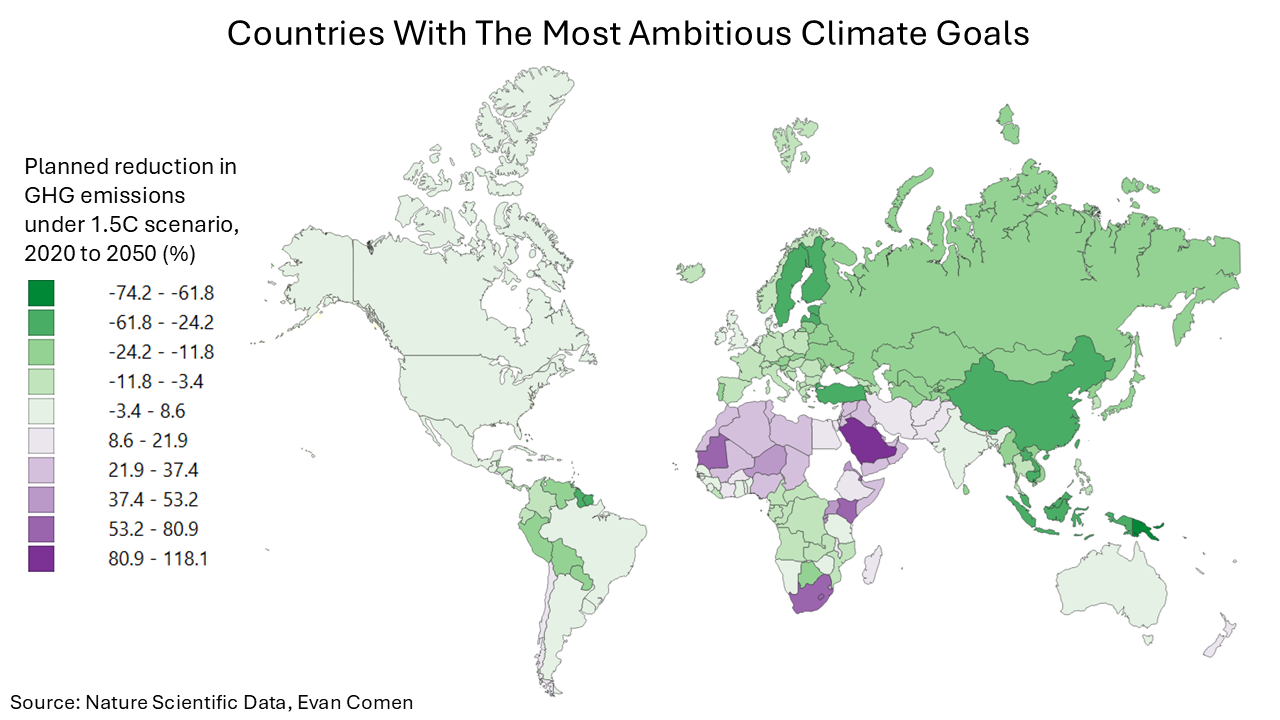
In a recent paper published in Nature Scientific Data, researchers from Ritsumeikan University attempted to bridge that gap by standardizing greenhouse gas reduction goals across hundreds of countries in the agriculture, forestry, and other land-use sectors. The resulting National Land-based Climate Mitigation Scenarios Dataset reveals striking contrasts in national targets — and shows which countries are planning the steepest reductions relative to current levels. While major emitters like China appear on the list, the most ambitious pledges come from small island nations facing the most immediate threat from climate change.
To identify the countries with the most ambitious climate goals, Climate Crisis 247 reviewed data from the National Land-based Climate Mitigation Scenarios Dataset published in Nature Scientific Data. Countries were ranked based on the percentage change in greenhouse gas emissions targeted under their land-based mitigation scenarios. Counties were ranked based on the percentage change in GHG emissions target for 2050 from the 2020 baseline. Population data are from the World Bank.
10. Indonesia

Indonesia’s climate ambitions reflect both the scale of its challenge and its opportunity. With a goal to cut greenhouse gas emissions by 30.2% by 2050, the world’s fourth most populous nation is targeting reductions largely through land-use reforms, reforestation, and curbing deforestation in key provinces such as Kalimantan and Sumatra. As a top emitter from agriculture and peatland degradation, Indonesia’s success could shift global emissions trajectories. Balancing rapid development with environmental protection remains its central test heading into COP30.
9. Suriname

Suriname already ranks among the world’s few carbon-negative nations, thanks to vast forests that absorb more carbon than the country emits. Still, it aims to reduce its emissions by 30.6% by 2050, an ambitious goal for a nation with fewer than 700,000 people. Maintaining that status amid pressure to expand mining and oil production is a growing challenge. Its strategy underscores how small, forest-rich countries are playing an outsized role in global mitigation efforts.
8. Estonia

With a target to cut emissions by 31% by mid-century, Estonia is one of Eastern Europe’s most ambitious climate actors. The country has made significant progress in phasing out oil shale, historically its biggest source of emissions. Continued investment in wind power and interconnections with Nordic energy markets could accelerate its transition. Estonia’s path highlights how former fossil-fuel economies can reinvent themselves as renewable leaders.
7. Finland

Finland’s 31.3% emissions-reduction target builds on a strong record of climate policy and technological innovation. The country already aims to reach carbon neutrality by 2035 — one of the earliest such goals in the world. Its strategy relies heavily on electrifying transport, expanding forest carbon sinks, and developing low-emission industrial processes. As the EU moves toward stricter climate targets, Finland is setting a benchmark for northern Europe.
6. Timor-Leste

Timor-Leste’s 31.8% emissions-cut target represents a major commitment for a small island nation still rebuilding its economy. The plan centers on sustainable agriculture, forest restoration, and renewable energy deployment. Vulnerable to both droughts and coastal flooding, the country faces steep adaptation costs alongside its mitigation efforts. Its progress will depend on access to international climate finance and technology transfer.
5. China

China’s 35.1% reduction goal in land-based emissions by 2050 signals an important shift for the world’s largest emitter. While the country continues to expand its renewable capacity at record pace, agricultural and forestry emissions remain a critical frontier. Beijing’s reforestation campaigns and “ecological civilization” policies aim to offset industrial output with massive carbon sinks. How China balances growth and green transition will define global progress toward the Paris targets.
4. Bhutan

Bhutan has long been a global model for sustainability, maintaining carbon-negative status through its extensive forests and constitutional mandate to preserve at least 60% forest cover. Its goal to reduce emissions by 38.8% by 2050 reinforces that leadership. The country’s hydroelectric exports to India provide both revenue and clean energy benefits for the region. Bhutan’s experience demonstrates that environmental stewardship can coexist with economic stability.
3. Malaysia

Malaysia’s plan to cut emissions by 44% by 2050 represents one of Southeast Asia’s most aggressive mitigation efforts. Deforestation curbs, peatland restoration, and expansion of renewable energy are central to its approach. Yet balancing palm oil exports with conservation remains a major hurdle. As a rapidly industrializing economy, Malaysia’s actions will influence the region’s overall ability to meet global climate goals.
2. Brunei Darussalam

Brunei’s target of a 61.8% emissions reduction by 2050 marks one of the steepest relative cuts in the world. The oil-rich sultanate is seeking to diversify away from fossil fuels, investing in renewable energy and sustainable urban development. With fewer than half a million residents, its per-capita footprint remains high, but national plans call for carbon capture and reforestation to bridge the gap. Brunei’s transition reflects the broader struggle of petro-states redefining their economies in the age of decarbonization.
1. Papua New Guinea

Papua New Guinea tops the list with an ambitious 74.2% emissions reduction target by 2050. Home to one of the largest tropical rainforests outside the Amazon and Congo basins, its success hinges on protecting forest carbon sinks and curbing illegal logging. The nation faces major implementation challenges due to limited infrastructure and governance capacity. Still, its commitment sends a powerful signal from the frontlines of climate vulnerability — and biodiversity preservation.