Are America’s Winters Disappearing because Of Heat?

Winter just isn’t what it used to be for most Americans. A large new study looking at 55 years of temperature data shows that winter – December through February – is now warming faster than any other season across almost the entire country.
Climate Central, a nonprofit research group, dug into daily temperature records from 1970 to 2025 for 244 U.S. cities. We’re talking every state, every climate zone, using data straight from the National Oceanic and Atmospheric Administration (NOAA).
It turns out 98% of cities have seen their average winter temperatures go up since 1970.
On average across those cities, winters have warmed by 3.9°F. That might not sound huge, but it really adds up.
The places getting hit hardest are in the Upper Midwest where temperatures are up 5.4°F, Alaska and the Northeast are both up 4.8°F, and the Ohio Valley has warmed by 4.4°F.
Some cities have seen absolutely massive changes:
- Burlington, Vermont is up a whopping 8.1°F
- Milwaukee, Wisconsin — +7.3°F
- Green Bay, Wisconsin — +7.0°F
- Waterloo, Iowa — +6.8°F
- Concord, New Hampshire — +6.7°F
- Toledo, Ohio — +6.7°F
When researchers started counting individual warm days instead of just looking at averages, the picture got even clearer:
Almost all – 97% of cities – now have more warmer-than-normal winter days compared to the early 1970s (they’re using 1991–2020 as the baseline here).
About 88% of cities – that’s 215 total – now get at least seven extra warm winter days every year.
The Northeast and Upper Midwest are seeing about 16 more warm winter days than they did in 1970.
The cities with the biggest jump in warm winter days are:
- Las Vegas, Nevada — +32 days
- San Francisco, California — +30 days
- Fresno, California — +30 days
- San Juan, Puerto Rico — +30 days
Here’s something else: when it does get cold, it’s just not as intense or long-lasting as it used to be – 210 cities now average 15 fewer nights below freezing, which is 32°F, than in the early 1970s.
Winter’s longest cold snaps have gotten shorter by an average of six days across 240 cities.
The coldest day of the entire year has warmed by 7°F on average in 242 cities.
This isn’t just about numbers on a thermometer. It’s changing how people live.
Out West, there’s less snowpack, which means summer water supplies are at risk for millions of people.
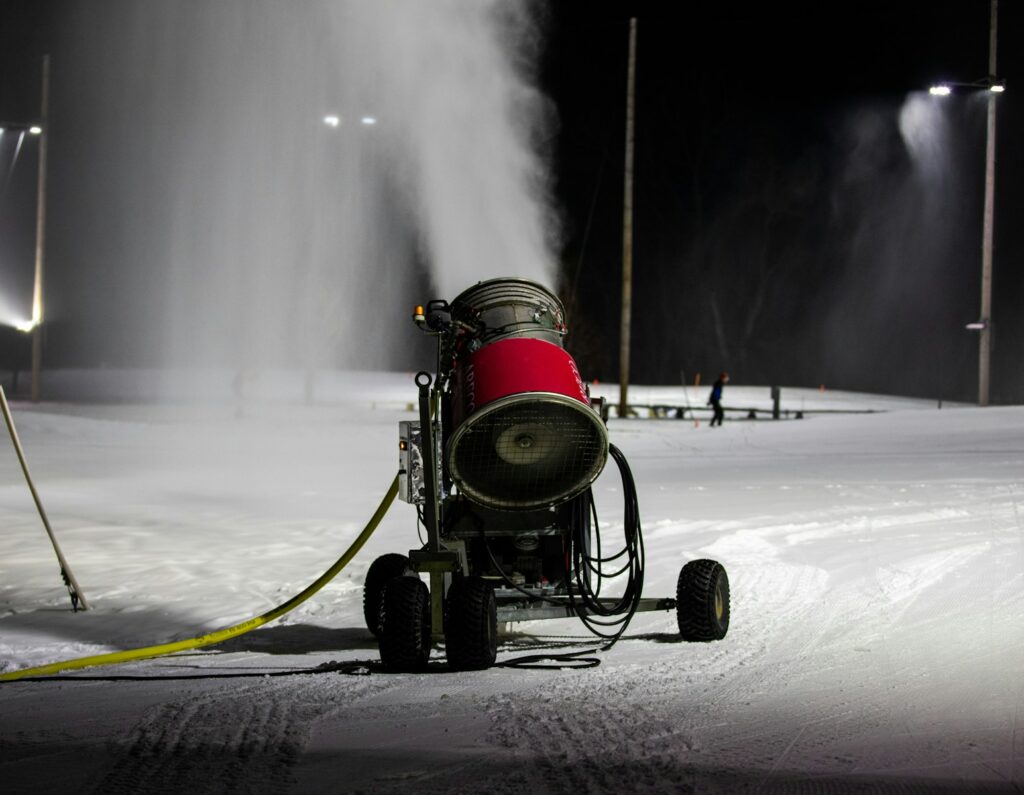
Ski resorts from California to New England are having to make more artificial snow just to stay open.
Maple syrup production is literally moving to Canada because Vermont and New York are getting too warm.
Fruit farmers in places like California, Washington, Georgia, and Florida are struggling. A lot of crops like cherries, apples, peaches, and almonds need a certain amount of cold to grow properly, and they’re just not getting it anymore.
Spring allergies are kicking in weeks earlier now because tree pollen is showing up in February in parts of the Northeast that used to stay frozen until early spring.
NOAA’s official forecast says the trend is continuing, largely because of La Niña conditions that showed up in September 2025.
Warmer-than-normal temps are expected across the southern U.S. and much of the Atlantic Coast. Similarly, wetter-than-normal conditions are forecast for the northern states from the Pacific Northwest to the Great Lakes.
That’s a classic La Niña pattern, and it lines up perfectly with the long-term warming we’ve already been seeing across most of the country.
The fastest warming on Earth right now is happening where and when it’s coldest: after dark, at high latitudes, and during winter, late fall, and early spring.
Climate Central’s chief meteorologist, Dr. Daniel Gilmore, put it perfectly: “We still get cold days. We just don’t get cold winters anymore.”