US Counties With The Most Data Centers
Earlier this month, Meta Platforms announced a planned $600 billion investment in U.S. infrastructure and jobs, with a large portion directed toward new AI-data centers. Meanwhile, reports show U.S. data-center investment linked to AI already accounts for nearly all GDP growth in the first half of 2025.
Soaring demand for data centers is powering one of the largest infrastructure build-outs in U.S. history. Tech companies are spending hundreds of billions of dollars in the race to control the future of AI, creating boomtowns overnight while placing unprecedented demand on local electric grids.
A number of factors – including availability of power, presence of high-capacity fiber-optic networks, tax incentives, and proximity to corporate customers – dictate where and how data centers are built. The scramble to build AI infrastructure has resulted in several well-known clusters of data centers in the U.S., such as “Data Center Alley” in Virginia, and many lesser-known pockets of computing infrastructure. In five counties, there are more than 30 known data centers per 100,000 residents. But while data centers offer the promise of economic development, they also threaten to strain power grids and hike utility bills. A closer look at the data reveals the counties with the highest concentrations of data centers.
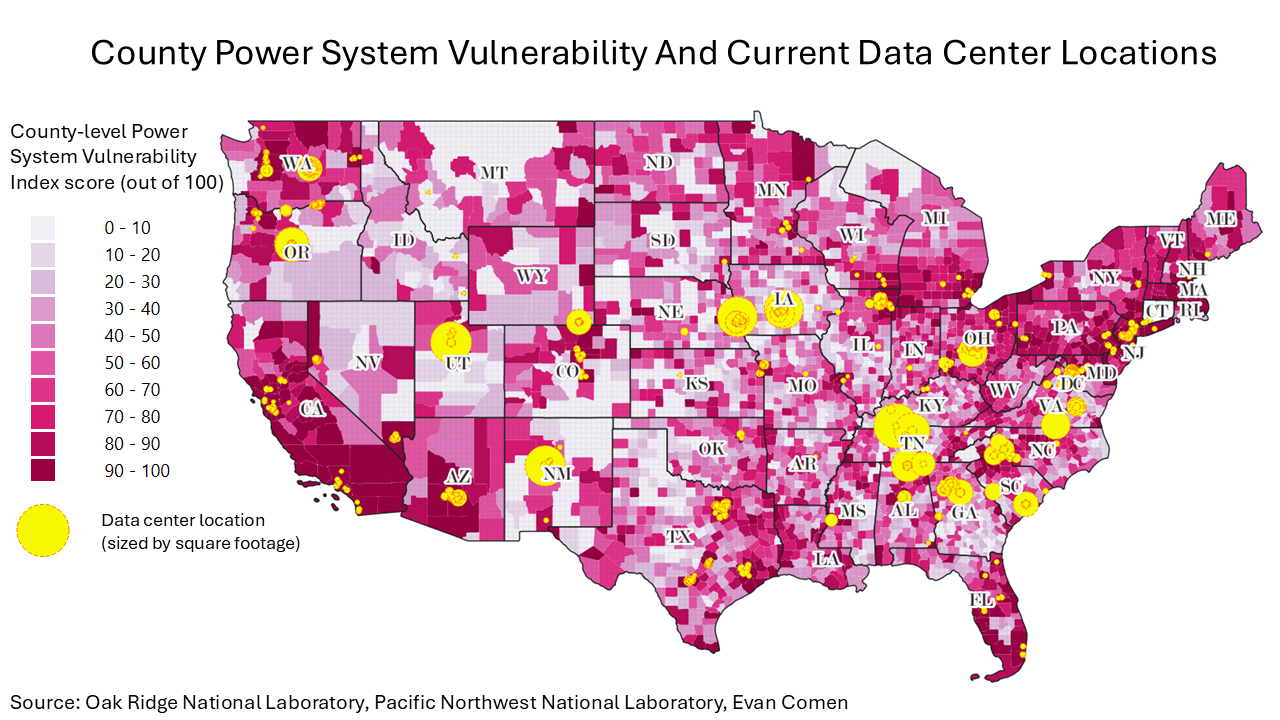
To identify the counties with the highest concentrations of data centers, Climate Crisis 247 reviewed data on known data center locations from the U.S. Department of Energy Office of Scientific and Technical Information. Counties were ranked based on the number of known data centers within their boundaries as of October 2025 per 100,000 residents. Supplemental data on the Power Stress Vulnerability Index are from the Oak Ridge National Laboratory. PSVI is based on grid load, redundancy, and historical outages.
20. Washington County, Oregon
Home to one of the highest per-capita concentrations of data centers in the Pacific Northwest — about 3.8 per 100,000 residents — Washington County has become a magnet for cloud and AI infrastructure investment. Companies like Flexential, Digital Realty, NTT RagingWire, and Stack Infrastructure have flocked to the area for its robust fiber networks, favorable tax policies, and proximity to Portland’s tech corridor. Yet with a Power Stress Vulnerability Index score of 92 out of 100, the county’s grid is showing signs of strain as power-hungry AI servers drive up local energy demand. The boom underscores Oregon’s dual identity as both an emerging digital powerhouse and a region grappling with its energy limits.
19. Douglas County, Georgia
With roughly 4.1 data centers per 100,000 residents, Douglas County anchors the western edge of metro Atlanta’s data-center sprawl. Google, Digital Realty, Flexential, and Centersquare all maintain major facilities here, attracted by Georgia Power’s industrial rates and proximity to the Hartsfield-Jackson fiber backbone. The county’s moderate grid-stress rating of 68 points to growing but manageable demand. As Atlanta’s AI infrastructure footprint expands, Douglas County’s industrial parks are turning into a key link in the Southeast’s digital corridor.
18. Berkeley County, South Carolina
Hosting about 4.2 data centers per 100,000 residents, Berkeley County has become one of the Southeast’s most active cloud-computing hubs. Google’s sprawling campus outside Charleston remains the anchor, drawing suppliers and fiber upgrades to the region. A Power Stress Vulnerability Index of 85 suggests rising strain on the area’s electricity supply as expansion continues. Once known for manufacturing, the county is fast evolving into an energy-intensive tech zone.
17. Somerset County, New Jersey
With 4.3 data centers per 100,000 residents, Somerset County exemplifies New Jersey’s long-standing role as a backup hub for the New York financial corridor. Major tenants include CyrusOne, Goldman Sachs, and Verizon Wireless. Its 95 out of 100 stress score reflects heavy grid demand in one of the nation’s densest utility markets. The county’s suburban footprint continues to blur the line between corporate office parks and full-scale data-processing campuses.
16. Polk County, Iowa
Home to 4.4 data centers per 100,000 residents, Polk County is the center of Iowa’s fast-growing data-center cluster. Meta’s massive Altoona campus dominates the skyline, backed by state tax credits and low electricity costs. With a moderate power-stress rating near 89, the area faces rising load as expansion continues. The Des Moines metro’s evolution from farmland to fiber hub reflects how the Midwest is powering AI’s next phase.
15. Platte County, Missouri
With 4.6 data centers per 100,000 residents, Platte County benefits from Kansas City’s strategic location in the national fiber network. Financial firms like BlackRock have set up large-scale computing operations here, drawn by land availability and connectivity. The county’s moderate grid-stress level of 79 points to growing but still sustainable power demand. As Missouri courts more AI infrastructure, Platte stands out as a midwestern test bed for balancing growth and grid stability.
14. Dallas County, Iowa
At 5.8 data centers per 100,000 residents, Dallas County is another Iowa hot spot for big-tech expansion. Apple and Microsoft lead a wave of hyperscale development, taking advantage of abundant wind energy and pro-business tax laws. The region’s modest stress score of 51 suggests a grid still able to absorb the surge. For Iowa, data centers have become the new cash crop — exporting computation instead of corn.
13. Sarpy County, Nebraska
With 7.2 data centers per 100,000 residents, Sarpy County anchors Nebraska’s digital-infrastructure boom. Meta, Google, and other hyperscalers have turned former farmland south of Omaha into one of the Midwest’s largest server clusters. Its moderate grid-stress rating of 55 hints at ongoing utility expansion to keep pace. Once a quiet suburban county, Sarpy now hosts a multi-billion-dollar slice of the AI economy.
12. Valencia County, New Mexico
Hosting 7.8 data centers per 100,000 residents, Valencia County has emerged as a major data-center site for the Southwest. Meta’s Los Lunas campus anchors operations, taking advantage of cheap land and proximity to renewable-energy projects. A moderate stress score of 49 indicates relatively stable grid conditions — for now. The build-out highlights how rural New Mexico has become an unlikely node in the global AI supply chain.
11. Licking County, Ohio
At 8.9 data centers per 100,000 residents, Licking County has transformed into central Ohio’s cloud-computing capital. Massive Amazon Web Services, Meta, and Google campuses dominate the New Albany area, alongside Intel’s adjacent semiconductor megasite. With a grid-stress score above 90, the region faces major infrastructure upgrades to sustain demand. The county’s future hinges on whether utilities can expand fast enough to power America’s industrial and digital revival.
10. Warren County, Iowa
Recording 11.2 data centers per 100,000 residents, Warren County continues Iowa’s climb up the AI-infrastructure ranks. Microsoft’s Project Osmium anchors the area’s growing cloud-footprint, fueled by cheap electricity and state incentives. A moderate stress score of 61 suggests manageable, but rising, power loads. The region exemplifies how suburban Des Moines has become a Midwest testing ground for AI-scale infrastructure.
9. Prince William County, Virginia
With 12.0 data centers per 100,000 residents, Prince William County sits at the edge of the world’s largest server corridor, neighboring Loudoun County’s “Data Center Alley.” CloudHQ, Google, and other hyperscalers are rapidly building new campuses despite local backlash over noise and energy use. Its 90-plus stress rating shows mounting strain on Northern Virginia’s power grid. The county’s development battles symbolize the tension between digital growth and community limits.
8. Laramie County, Wyoming
Home to 13.9 data centers per 100,000 residents, Laramie County has become a high-altitude haven for cloud computing. Microsoft, MineOne, and the NCAR supercomputing center anchor operations in the Cheyenne area. With a low stress score of 23, abundant wind and open space keep energy pressures mild. The region illustrates how states with surplus renewable power are attracting data-intensive industries.
7. Pottawattamie County, Iowa
At 21.4 data centers per 100,000 residents, Pottawattamie County is among the nation’s densest clusters of server farms. Google and CyrusOne dominate Council Bluffs, leveraging Iowa’s power incentives and central location. A moderate stress score of 73 shows growing electricity use as new facilities come online. The area’s digital boom is reshaping western Iowa into a core node of the continental internet backbone.
6. Douglas County, Washington
Recording 29.7 data centers per 100,000 residents, Douglas County is one of the Pacific Northwest’s earliest data-center strongholds. Low-cost hydropower from the Columbia River and cool desert air make it ideal for energy-intensive computing. Its moderate stress rating of 53 reflects steady but sustainable load growth. The mix of green power and AI demand positions the region as a model for low-carbon cloud expansion.
5. Umatilla County, Oregon
With 31.2 data centers per 100,000 residents, Umatilla County hosts one of Amazon’s largest clusters outside Virginia. Cheap hydroelectricity and wide-open land have turned the Columbia Plateau into a magnet for hyperscalers. A moderate stress score of 71 suggests growing tension between industrial load and rural grid capacity. The area has quietly become a cornerstone of Amazon’s western cloud empire.
4. Grant County, Washington
At 37.8 data centers per 100,000 residents, Grant County is another hydropower-driven hub in central Washington. Microsoft, NTT Data, and H5 Data Centers operate massive facilities near Quincy, drawn by some of the cheapest electricity in the nation. Its moderate stress level of 78 shows utilities racing to keep pace with surging demand. The county exemplifies how renewable energy assets are shaping the geography of AI.
3. Loudoun County, Virginia
Dubbed “Data Center Alley,” Loudoun County remains the epicenter of the world’s internet traffic. AWS, Google, NTT, and Digital Realty all operate sprawling campuses in Ashburn. Its 92.5 stress score underscores a grid under extreme pressure, prompting state-level planning for new transmission lines. Loudoun’s transformation captures both the promise and the cost of hosting the digital age.
2. Crook County, Oregon
Home to 50.7 data centers per 100,000 residents, Crook County punches far above its weight in the AI economy. Meta and Apple dominate the landscape around Prineville, where reliable hydropower and cool high-desert air keep costs low. With a stress score of 16, the grid remains unusually resilient despite massive computing loads. The county’s balance of renewable energy and rural development makes it a showcase for sustainable cloud expansion.
1. Morrow County, Oregon
Topping the list with 187.8 data centers per 100,000 residents, Morrow County has become the densest data-center region in America. Amazon Web Services’ sprawling us-west-2 complex anchors the region, taking advantage of cheap hydropower and sparse population. A low stress score of 35 shows ample capacity, though power exports already stretch the grid’s reach. The remote Columbia River county now sits at the very heart of the global AI infrastructure boom.
More from ClimateCrisis 247
- Is coal really making a comeback?
- States With the Deadliest Tornadoes Since 1950
- The Driest Places in America This Year
- Due to Low Sales, These Are The EVs That Disappeared This Year