America’s 15 Most Water-Starved Cities
Nationwide, a majority of the U.S. population lives in sustainable water basins. Water supply outweighs demand in most counties, and on a national level the U.S. ranks 71st out of 181 countries in baseline water stress.
In some municipalities, however, the net consumption of water is far greater than renewable freshwater available at the sub-basin level, putting serious strain on water systems. In several cities – like Chandler, Arizona, and Lubbock, Texas – year-round water consumption outweighs renewable water supply by sevenfold. In these water scarce cities, residential and industrial consumers depend on non-renewable and imported water sources, relying on river diversions from hundreds of miles away or groundwater pumps that can draw down aquifers and result in overdrafting. A closer look at the data reveals the cities where water demand outpaces supply the most.
To determine America’s thirstiest cities, Climate Crisis 247 reviewed data on water demand and supply from the World Resources Institute. Cities are ranked based on average baseline water stress – the ratio of net water consumption to available renewable freshwater available to a sub-basin, which includes surface flow, interflow, and groundwater recharge. Data was aggregated from the sub-basin level to cities using QGIS. Supplemental data on drought conditions are from the U.S. Drought Monitor. Only cities with at least 100,000 residents were considered, with only the highest-ranking city in each county included.
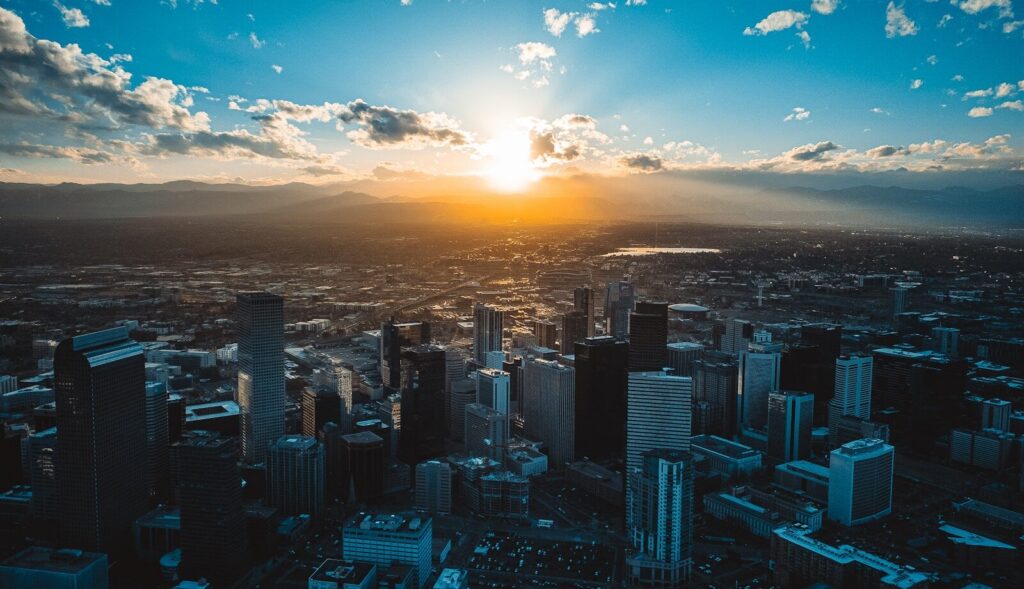
15. Denver, CO
- Annual water withdrawals: 224.3% of renewable supply
- Land area that is abnormally dry: 35.3%
- Value of all homes: $104.5 billion
- Total population: 710,800
14. Clovis, CA
- Annual water withdrawals: 280.5% of renewable supply
- Land area that is abnormally dry: 100.0%
- Value of all homes: $12.2 billion
- Total population: 120,607
13. Brownsville, TX
- Annual water withdrawals: 299.1% of renewable supply
- Land area that is abnormally dry: 0.0%
- Value of all homes: $4.7 billion
- Total population: 186,999
12. San Diego, CA
- Annual water withdrawals: 339.5% of renewable supply
- Land area that is abnormally dry: 88.8%
- Value of all homes: $236.0 billion
- Total population: 1.4 million
11. Oxnard, CA
- Annual water withdrawals: 349.8% of renewable supply
- Land area that is abnormally dry: 68.9%
- Value of all homes: $16.8 billion
- Total population: 202,279
10. Bakersfield, CA
- Annual water withdrawals: 364.1% of renewable supply
- Land area that is abnormally dry: 100.0%
- Value of all homes: $26.3 billion
- Total population: 404,321
9. Pomona, CA
- Annual water withdrawals: 440.8% of renewable supply
- Land area that is abnormally dry: 100.0%
- Value of all homes: $11.6 billion
- Total population: 149,831
8. Edinburg, TX
- Annual water withdrawals: 458.0% of renewable supply
- Land area that is abnormally dry: 0.0%
- Value of all homes: $3.2 billion
- Total population: 100,964
7. Visalia, CA
- Annual water withdrawals: 497.9% of renewable supply
- Land area that is abnormally dry: 100.0%
- Value of all homes: $9.3 billion
- Total population: 141,466
6. San Bernardino, CA
- Annual water withdrawals: 530.7% of renewable supply
- Land area that is abnormally dry: 100.0%
- Value of all homes: $11.2 billion
- Total population: 221,041
5. Santa Ana, CA
- Annual water withdrawals: 530.7% of renewable supply
- Land area that is abnormally dry: 100.0%
- Value of all homes: $22.5 billion
- Total population: 311,379
4. Riverside, CA
- Annual water withdrawals: 530.7% of renewable supply
- Land area that is abnormally dry: 100.0%
- Value of all homes: $26.9 billion
- Total population: 316,076
3. Lubbock, TX
- Annual water withdrawals: 671.1% of renewable supply
- Land area that is abnormally dry: 0.0%
- Value of all homes: $12.0 billion
- Total population: 258,190
2. San Tan Valley, AZ
- Annual water withdrawals: 684.3% of renewable supply
- Land area that is abnormally dry: 100.0%
- Value of all homes: $9.4 billion
- Total population: 101,207
1. Chandler, AZ
- Annual water withdrawals: 684.3% of renewable supply
- Land area that is abnormally dry: 100.0%
- Value of all homes: $31.8 billion
- Total population: 275,618
More from ClimateCrisis 247
- The Worst Back-to-Back Hurricanes in US History
- The Deadliest Hurricanes To Hit the US in the last half century
- States Producing The Most Greenhouse Gas Emissions
- Sea Level Rise Will Cost These U.S. Cities Billions by 2040