Climate Change Putting These Historic Places At Risk Of Wildfire
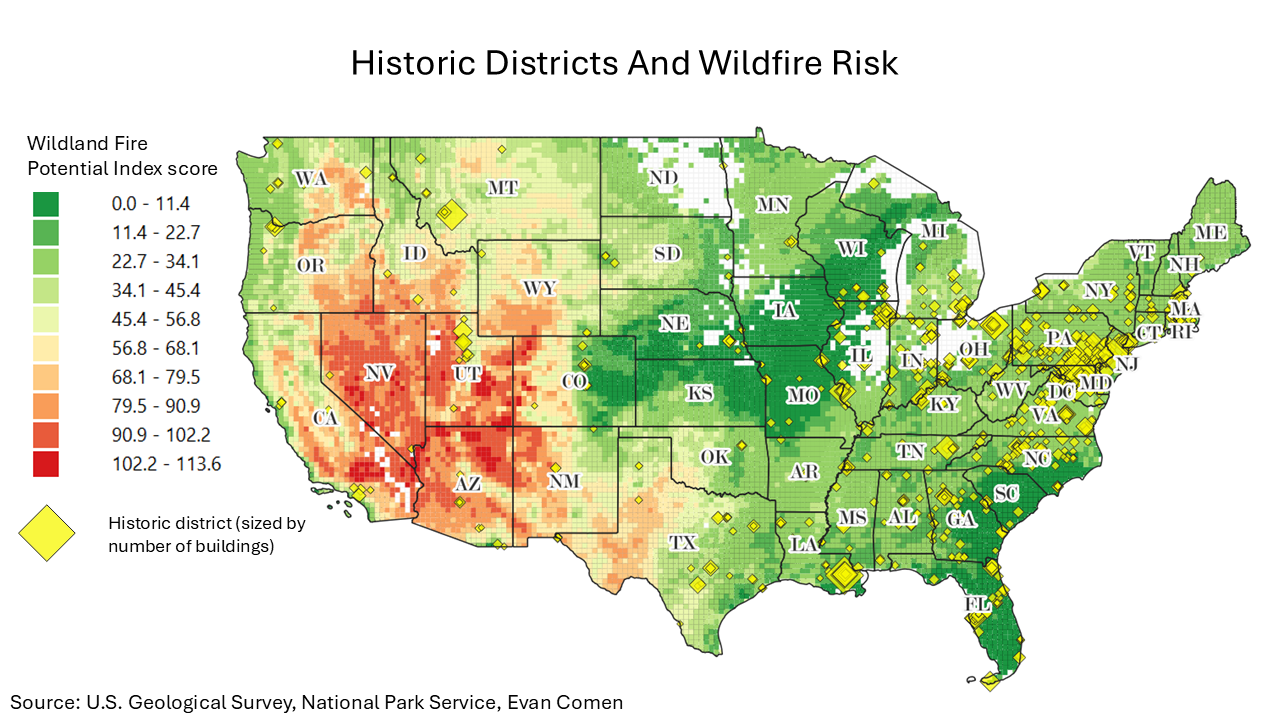
This past summer, the Dragon Bravo Fire destroyed dozens of structures in Grand Canyon National Park, including the historic Grand Canyon Lodge. As rising temperatures and prolonged drought continue to elevate wildfire danger across the country, many historic neighborhoods face particularly high risk.
While the temperate East Coast is home to the nation’s oldest structures, several important historic sites in the West sit squarely within high-risk fire zones. In Colorado, for instance, the Telluride Historic District – where wildfire potential ranks among the highest in the country – contains dozens of 19th-century buildings that preserve the boomtown architecture of its mining past. Other historic areas at elevated risk include the Huning Highlands Historic District in Albuquerque and the Helper Commercial District in Utah. A closer look at the data reveals the historic neighborhoods with the greatest wildfire risk.
To determine the historic neighborhoods with the greatest wildfire risk, Climate Crisis 247 reviewed data on wildland fire potential from the U.S. Geological Survey. Historic districts were ranked based on the average Wildland Fire Potential Index score within their boundaries as of November 11, 2025. USGS data is based on factors such as vegetation type, fuel load, historical fire occurrence, wind, and topography. Spatial boundaries for historic districts used in calculating zonal averages are from the National Park Service.
5. East Third Avenue Historic Residential District (Durango, CO)
A tree-lined showcase of late 19th- and early 20th-century architecture, Durango’s East Third Avenue Historic District reflects the prosperity of the city’s mining and railroad boom. The 98 homes and civic buildings, many in Queen Anne and Colonial Revival styles, remain remarkably intact. But surrounded by dry forest and steep slopes, the neighborhood’s charm comes with risk: its Wildland Fire Potential Index score of 102.4 out of 150 makes it one of the most fire-prone historic districts in the country. Listed on the National Register in 1984, it faces mounting threats as the Southwest grows hotter and drier.
4. Helper Commercial District (Helper, UT)
Once a bustling railroad and coal-mining hub, Helper’s downtown retains the look and feel of an early 20th-century Western boomtown. The 288 structures within the district include brick commercial buildings, hotels, and civic halls that line its compact main street. Its average wildfire potential score of 102.6 reflects the high danger posed by dry canyon winds and sparse vegetation.
3. Main Avenue Historic District (Durango, CO)
Durango’s Main Avenue Historic District captures the city’s frontier origins, with 86 buildings ranging from red-brick Victorian storefronts to ornate hotels dating to the 1880s. Today, it remains the centerpiece of Durango’s tourism economy, and one of its most at-risk zones. With a Wildland Fire Potential Index of 103.1, the heart of the city sits near forested slopes that could channel flames toward downtown during a major blaze. Listed in 1980, the district’s preservation now depends on balancing heritage tourism with wildfire adaptation.
2. Las Vegas High School Neighborhood Historic District (Las Vegas, NV)
The Las Vegas High School Neighborhood Historic District represents one of the city’s earliest planned residential areas, featuring Spanish Colonial Revival and Art Deco homes built in the 1930s and 1940s. Its 150 structures surround the landmark Las Vegas High School, an Art Deco gem. Despite being in the desert, the district’s Wildland Fire Potential Index of 107.0 reflects the increasing threat of heat, drought, and urban interface fires fueled by dry vegetation. Added to the National Register in 1991, the area highlights how even urban historic neighborhoods are not immune to climate-driven fire risk.
1. Boulevard Park (Sacramento, CA)
Laid out in the early 1900s as one of Sacramento’s first streetcar suburbs, Boulevard Park features 238 structures in Craftsman, Prairie, and Period Revival styles. Its tree-lined streets were designed for shade and walkability, but those same aging trees can amplify fire hazards as summers grow longer and hotter. With a Wildland Fire Potential Index score of 109.8 out of 150, it ranks as the most at-risk historic neighborhood in the nation. Added to the National Register in 2011, Boulevard Park stands at the intersection of heritage preservation and the escalating threat of urban wildfire.
Sponsor
Find a Vetted Financial Advisor
- Finding a fiduciary financial advisor doesn't have to be hard. SmartAsset's free tool matches you with up to 3 financial advisors that serve your area in 5 minutes.
- Each advisor has been vetted by SmartAsset and is held to a fiduciary standard to act in your best interests. Get on the path toward achieving your financial goals!