The World’s Largest Meat Company Abandons Its Climate and Deforestation Goals
After encountering the “immense” challenge of actually executing its net-zero goal by 2040, JBS said it will instead lower its “emissions intensity.”
By Georgina Gustin
July 13, 2026
This article originally appeared on Inside Climate News, a nonprofit, non-partisan news organization that covers climate, energy and the environment. Sign up for their newsletter here.
The world’s largest meat company is backing away from its climate and deforestation commitments after claiming for several years that reducing its greenhouse gas emissions was a key goal.
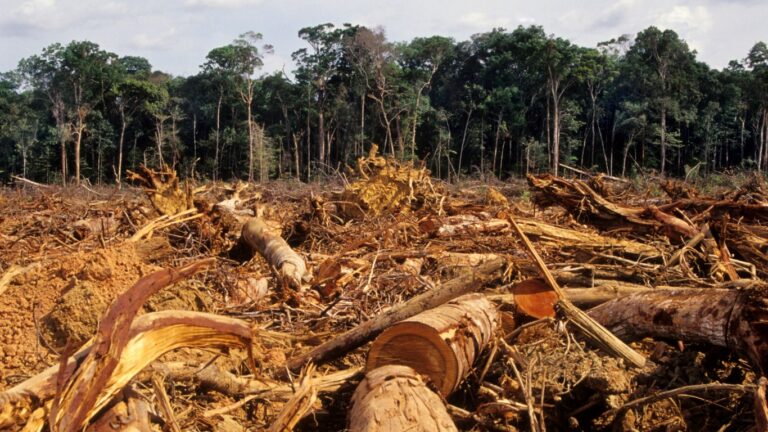
In its recent annual sustainability report, released last week, JBS dropped its ambitious commitment to reach net-zero emissions by 2040 and omitted any mentions of its previous goal to eliminate deforestation across its supply chains in Brazil. The move comes as other major livestock companies and grain traders in the livestock supply chain appear to be shrinking their climate ambitions, including jettisoning membership in a successful moratorium on deforestation in the Brazilian Amazon.
“They have removed any reference to their net-zero 2040 targets and they have also removed any references to the time-bound deforestation commitment that they had held,” said UK-based Gemma Hoskins, a director with Mighty Earth, an environmental group that has long tracked JBS’s activity. “It’s very disappointing.”
In a post accompanying last week’s report, Jason Weller, JBS’s chief sustainability officer, said accounting for emissions from its supply chain—where nearly 97 percent of its emissions originate—is uniquely complex.
“The further we got into execution, the clearer it became that a Net Zero goal spanning hundreds of thousands of independent agricultural producers across tens of millions of hectares in dozens of countries—each with different practices, different baselines, and no standardized measurement infrastructure—is an immense challenge,” Weller said, adding that the company still plans to strengthen its framework “so our goals better reflect where we can take direct action.”
In the report, JBS says it plans to focus on addressing emissions from its direct operations, which account for roughly 2 to 3 percent of its emissions, rather than from its supply chain.
A JBS spokesperson did not respond to specific questions from Inside Climate News, but wrote in an email that the company’s “updated sustainability framework reflects a disciplined evolution, strengthening operational fundamentals, advancing measurable progress, and building long-term supply chain resilience. It aligns more closely with customer expectations and business performance while reinforcing our commitment to efficiency, transparency, and responsible food production.”
JBS, long based in Brazil but recently redomiciled in the Netherlands, has a greenhouse gas footprint comparable to Spain’s, though its planned global expansion could increase its impact significantly. The company has huge operations in the United States and across much of Latin America and Europe, but has also recently opened production facilities in the Middle East and Asia, and has announced plans to open a massive operation in Nigeria, its first in Africa.
In 2019, JBS officials claimed the company’s global beef, pork and chicken production had little to no climate impact, but it reversed course in 2020 when it made the now-abandoned 2040 net-zero commitment. That pledge and others, including those aiming to halt or slow deforestation by specific years, became a key part of the company’s multi-year campaign to list on the New York Stock Exchange, a goal it achieved in 2025.
The Securities and Exchange Commission approved the listing days after campaign filings showed that Pilgrim’s Pride, a major JBS subsidiary, was the largest corporate contributor to Trump’s inauguration committee, donating $5 million.
Billionaire Brazilian brothers Joesley and Wesley Batista, JBS’s majority shareholders, have since played a role in the administration’s foreign diplomacy efforts, including in Brazil, according to Reuters.
Environmental and anti-corruption groups campaigned against the listing, noting the company’s links to deforestation, environmental destruction and corruption, including bribery charges that landed the Batista brothers in jail. They say the company is backtracking on climate goals, having strategically burnished its credentials.
“These net-zero claims were really about legitimizing an illegitimate business,” Hoskins said. “They used the net-zero banner to position themselves as having some kind of climate leadership. It helped legitimize what has been a very corrupt business.”
Hoskins noted that JBS was able to use the net-zero claims to issue sustainability-linked bonds at very low interest rates. “That allowed them to have an enormous amount of capital to deliver on an aggressive growth strategy and to put themselves forward through the IPO on the New York Stock Exchange,” Hoskins said. “I think the problems are much bigger than whether they’ve walked away from a climate target and much more about exactly how they’ve used that to bring in enormous amounts of finance.”
Globally, meat production accounts for at least 16.5 percent of total greenhouse gas emissions, coming both from direct emissions from cattle, as well as the deforestation and land-use impacts from growing grain to feed the world’s cows, chickens and pigs.
In greenhouse gas accounting terms, these supply chain emissions are categorized as Scope 3 emissions. Scope 1 emissions come directly from a company’s operations and Scope 2 from its energy use.
In its report, JBS said it intends to limit the “emissions intensity” of its Scope 1 and 2 emissions, which represent a fraction of its overall carbon footprint. Emissions intensity is calculated as emissions released per unit of a given output—a pound of beef or megawatt of energy—and does not capture total emissions.
“Make no mistake, these were always empty promises that JBS was never realistically going to deliver,” said Daniela Montalto, a campaigner at Greenpeace UK, in a statement. “But now JBS appears to have given its supply chain—be it livestock or animal feed—carte blanche for the wholesale sacrifice of ecosystems from the Amazon to new frontiers in sub-Saharan Africa, particularly in regions where national regulations or enforcement are weak.”
More from ClimateCrisis 247
- The 10 Most Sustainable Countries In The World
- States Where Tax Payers Will Pay The Most for Rising Sea Levels
- The 10 Least Sustainable Countries In The World
- The Worst Back-to-Back Hurricanes in US History