Will Extreme Heat Derail the World Cup in These 10 Cities?

Later this month, the United States, along with Canada and Mexico, will host the 2026 FIFA World Cup. Over the course of the tournament, 48 national teams will compete in major cities across North America. In most of these places, matches will be held in open air venues — subjecting both players and fans to the extreme temperatures that have become increasingly common in the summer months.
According to a recent report from the non-profit research organization Climate Central, temperatures exceeding 82.4°F can negatively impact gameplay — effecting players’ running speed, distance, and frequency during a match. As temperatures rise beyond that threshold and into the 90s, risks to player health also increase, particularly in humid conditions. Notably, there are three World Cup host cities – Atlanta, Dallas, and Houston — where matches will be held in fully-climate controlled stadiums. These same places are also among those where game-day temperatures are expected to be highest.
Still, there are more than a dozen other cities across the United States, Canada, and Mexico that will also host matchups throughout the tournament. In many of them, prediction models indicate a strong likelihood that extreme heat will detract from the level of play, and possibly even present health risks.
Using data from Climate Central, Climate Crisis 247 identified the cities where extreme heat poses the greatest risk to the 2026 World Cup. We ranked all host cities on the chances that temperatures exceed 82.4°F on scheduled game days. Cities with fully climate-controlled stadiums were excluded from analysis. Normal daily highs in the months of June and July for American host cities are the latest 30-year averages available from the National Oceanic and Atmospheric Administration. For cities outside the United States, temperature norms are from Weather Spark, a global climate reference platform. Additional supplemental data on the impact climate change has had on local heat risk are from Climate Central. Only the 10 World Cup host cities with the highest risk of performance-impairing heat on game days are ranked.
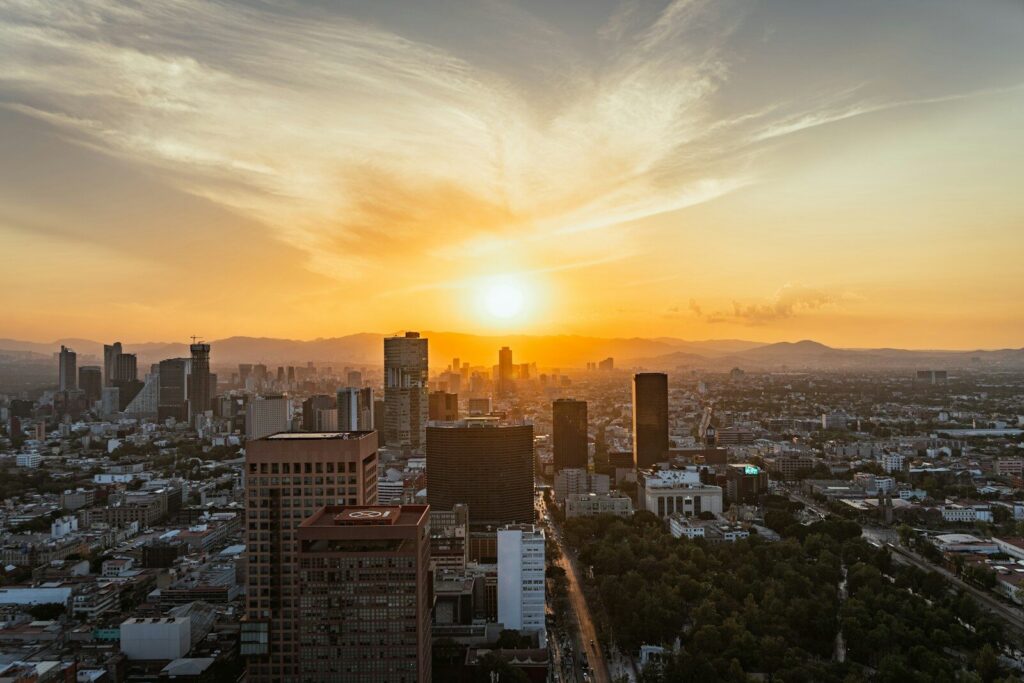
10. Estadio Azteca – Mexico City, Mexico
- Odds of performance-impairing heat in city during 2026 World Cup: 9%-19%
- Odds of performance-impairing heat absent the effects of climate change: 4%-10%
- World Cup game dates at venue: June 11, 17, 24, 30, 2026; July 5, 2026
- Stadium type: Open-air
- Average local daily high temperatures: 77.0°F in June; 74.0°F in July
9. Levi’s Stadium – San Francisco Bay Area, California
- Odds of performance-impairing heat in city during 2026 World Cup: 17%-26%
- Odds of performance-impairing heat absent the effects of climate change: 16%-27%
- World Cup game dates at venue: June 13, 16, 19, 22, 25, 2026; July 1, 2026
- Stadium type: Open-air
- Average local daily high temperatures: 71.1°F in June; 72.2°F in July
8. Gillette Stadium – Boston, Massachusetts
- Odds of performance-impairing heat in city during 2026 World Cup: 16%-37%
- Odds of performance-impairing heat absent the effects of climate change: 13%-26%
- World Cup game dates at venue: June 13, 16, 19, 23, 26, 29, 2026; July 9, 2026
- Stadium type: Open-air
- Average local daily high temperatures: 75.9°F in June; 81.9°F in July
7. MetLife Stadium – East Rutherford, New Jersey
- Odds of performance-impairing heat in city during 2026 World Cup: 20%-47%
- Odds of performance-impairing heat absent the effects of climate change: 13%-30%
- World Cup game dates at venue: June 13, 16, 22, 25, 27, 30, 2026; July 5, 19, 2026
- Stadium type: Open-air
- Average local daily high temperatures: 79.7°F in June; 84.9°F in July
6. SoFi Stadium – Los Angeles, California
- Odds of performance-impairing heat in city during 2026 World Cup: 32%-62%
- Odds of performance-impairing heat absent the effects of climate change: 24%-53%
- World Cup game dates at venue: June 12, 25, 18, 21, 25, 28, 2026; July 2, 10, 2026
- Stadium type: Passive cooling
- Average local daily high temperatures: 70.7°F in June; 73.9°F in July
5. Lincoln Financial Field – Philadelphia, Pennsylvania
- Odds of performance-impairing heat in city during 2026 World Cup: 43%-63%
- Odds of performance-impairing heat absent the effects of climate change: 32%-46%
- World Cup game dates at venue: June 14, 19, 22, 25, 27, 2026; July 4, 2026
- Stadium type: Open-air
- Average local daily high temperatures: 83.1°F in June; 87.8°F in July
4. Arrowhead Stadium – Kansas City, Missouri
- Odds of performance-impairing heat in city during 2026 World Cup: 68%-86%
- Odds of performance-impairing heat absent the effects of climate change: 55%-82%
- World Cup game dates at venue: June 16, 20, 25, 27, 2026; July 3, 11, 2026
- Stadium type: Open-air
- Average local daily high temperatures: 83.2°F in June; 87.2°F in July
3. Estadio Monterrey – Monterrey, Mexico
- Odds of performance-impairing heat in city during 2026 World Cup: 78%-79%
- Odds of performance-impairing heat absent the effects of climate change: 64%-66%
- World Cup game dates at venue: June 14, 20, 24, 29, 2026
- Stadium type: Open-air
- Average local daily high temperatures: 93°F in June; 94°F in July
2. Estadio Guadalajara – Guadalajara, Mexico
- Odds of performance-impairing heat in city during 2026 World Cup: 70%-88%
- Odds of performance-impairing heat absent the effects of climate change: 32%-68%
- World Cup game dates at venue: June 11, 18, 23, 26, 2026
- Stadium type: Open-air
- Average local daily high temperatures: 84°F in June; 79°F in July
1. Hard Rock Stadium – Miami, Florida
- Odds of performance-impairing heat in city during 2026 World Cup: 88%-98%
- Odds of performance-impairing heat absent the effects of climate change: 68%-90%
- World Cup game dates at venue: June 15, 21, 24, 27, 2026; July 3, 11, 18, 2026
- Stadium type: Open-air (partial shade)
- Average local daily high temperatures: 89.3°F in June; 90.7°F in July
More from ClimateCrisis 247
- Is coal really making a comeback?
- States With the Deadliest Tornadoes Since 1950
- The Driest Places in America This Year
- Due to Low Sales, These Are The EVs That Disappeared This Year